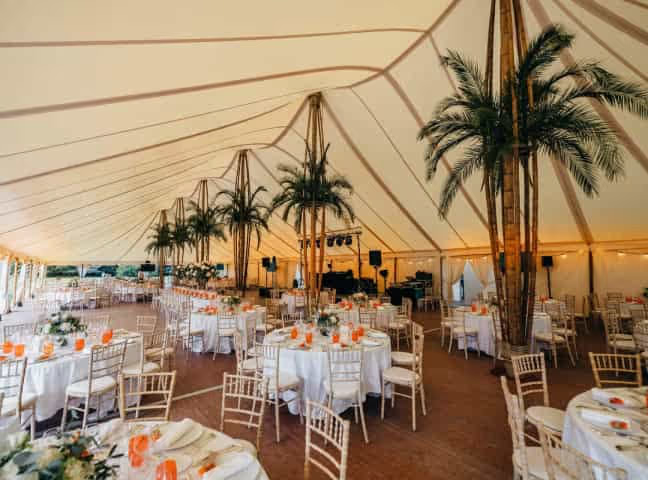
An outdoor festival, a wedding under a marquee, a corporate reception… every event welcoming the public under a temporary structure engages the responsibility of its organiser. A cornerstone of safety for itinerant ERPs, the CTS (Chapiteaux, Tentes et Structures — Marquees, Tents and Structures) regulation governs these installations to protect both the admitted public and the organiser.Atawa breaks down the requirements of CTS standards and supports you so that every technical detail is under control, from the first sketch to the big day.

What is the CTS-type ERP Regulation?
Definition and legal framework of the Construction Code
The Construction Code categorises as CTS-type any itinerant Establishment Receiving the Public (ERP), enclosed or open, fitted with a flexible covering. In practical terms, a reception marquee, a festival tent or an ephemeral structure falls into this category as soon as the number of admitted members of the public reaches 20 persons.
In this context, the structure falls under the fire and panic safety regulation, derived from the decree of 25 June 1980, supplemented by the decree of 23 January 1985 for provisions specific to CTS structures.
The objective is clear: ensure mechanical stability against adverse weather (wind, snow, rain) and allow smooth evacuation in the event of an incident.
The safety register: the identity card of your event structure
Every marquee, tent or CTS structure must have its own safety register, which centralises:
- the certificate of conformity;
- inspection reports;
- site plans and electrical diagrams;
- evacuation instructions.
This administrative document certifies that the equipment has been inspected by an approved body — a mandatory check every two years. The register must be made available to the authorities and the safety commission at each use.
The Technical Requirements of CTS Standards for Fire Safety
Reaction to fire and material classification
Fire safety is first and foremost based on the reaction to fire of the materials used. Canvases, tarpaulins and coverings of a CTS-type ERP must meet a minimum M2 classification (difficult to ignite) or M1. With this classification, fire risks are reduced and the release of toxic gases in the event of combustion is limited.
These general provisions cover both the outer envelope and the interior fittings: carpets, drapes, stage coverings, decorative panels, and so on.
Fire safety under a marquee: your summary
Safety lighting and evacuation calculation method
Safety lighting is mandatory to mark emergency exits, even in daylight — its purpose being to anticipate any general power cut.
The calculation method for circulation routes follows strict logic: the number of passage units required based on the total headcount (public and staff combined). This calculation is designed to prevent any panic movement.
Atawa: a CTS-compliant supplier for your event
Approved structures and tailored support
At Atawa, every standard tent and marquee is delivered with its certificate of conformity, proof of its approval by the competent authorities. Atypical projects benefit from a structural calculation report produced by Atawa's own engineers. This document validates resistance to wind and snow loads, based on the actual conditions of the site.
The Atawa expertise advantage
We provide you with a complete technical file that streamlines administrative procedures with the town hall or prefecture.
Assistance during the safety commission inspection and installation
Upon completion of the installation, we issue an erection compliance certificate, an essential component of the safety register. This document confirms that the structure has been assembled in accordance with regulatory requirements.
As an expert CTS-type supplier, we can be physically present during the safety commission inspection to answer inspectors' technical questions.
The Stakes of Compliance for Professionals and Private Clients
Responsibility and protection of the admitted public
Compliance with the fire and panic safety code protects the organiser from criminal and civil sanctions in the event of an incident. A non-compliant installation is liable to immediate administrative closure. The consequences, beyond cancellation, are very real:
- financial loss;
- reputational damage;
- disruption to planned sporting or cultural activities.
The importance of the certificate of conformity for your insurance
Without fire reaction certificates, the erection compliance certificate and an up-to-date safety register, insurers may refuse to cover claims in the event of an accident. Atawa safeguards your investment by delivering all the documents required for your public liability cover to remain valid.
Key Takeaways: 5 Essential Points on CTS Standards
- Mandatory compliance: any itinerant structure with a flexible covering accommodating 20 or more people falls under CTS regulation.
- Essential documents: the safety register, erection compliance certificate and M2 fire reaction certificate are all required before opening to the public.
- Fire safety: materials must meet a minimum M2 classification, and safety lighting must mark every emergency exit.
- Insurance: without a valid certificate of conformity or up-to-date certificates, insurers may refuse to cover claims in the event of an incident.
- Atawa's support: from the structural calculation report to physical attendance at the safety commission inspection, Atawa manages the entire regulatory process.
Conclusion
CTS standards form the foundation of trust on which the success of any marquee or tent event rests. Mastering these requirements means protecting your guests, securing your liability and preserving your reputation. Atawa puts its regulatory expertise at the service of your project, to deliver infrastructure that is elegant, robust and fully compliant.
Entrust us with your project and benefit from infrastructure compliant with CTS standards.
FAQ: Your Frequently Asked Questions on CTS Standards
How do I know whether my event requires a CTS structure?
If your installation is temporary (less than 6 months) and accommodates more than 19 people, you fall under CTS regulation.
For what type of event and what headcount does the CTS standard apply?
From 20 people upwards, the standard applies. This regulatory framework covers private receptions, festivals, itinerant events with a covering, and even temporary structures for cultural activities.
What documents are essential on the day?
You must present the certificate of conformity, the erection compliance certificate and the fireproofing certificates for the canvas.


Ile-de-France・Centre-Val de Loire
01 79 75 89 87

Provence-Alpes-Côte d’Azur・Corse
04 84 49 62 64
Nouvelle-Aquitaine
05 35 54 59 88
Hauts-de-France・Normandie
03 74 09 83 62
Bretagne・Pays de la Loire
02 57 64 07 94
Grand-Est・Bourgogne
03 52 74 06 68
Auvergne-Rhône-Alpes
04 28 29 61 35
Occitanie
05 82 95 39 28
Switzerland
+41 076 504 33 02
subtitle
Product name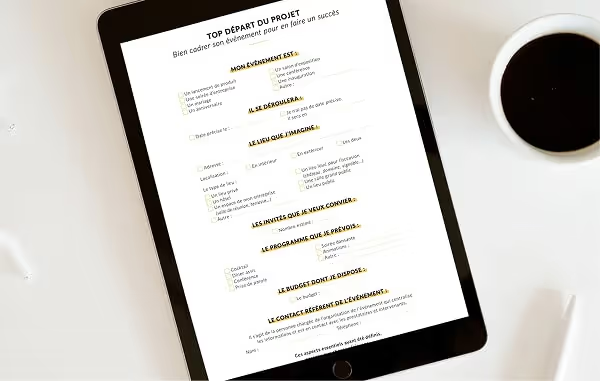
Discover the Atawa Guide
The Atawa Guide is the new essential tool for organizing your events: from launching your project to bringing it to life, no detail has been overlooked to ensure your event's success.