Do you own a château, a Provençal farmhouse or a property with character? Turning this private venue into an event reception space can be an excellent opportunity to enhance the value of your property, host private events, and develop a new source of income.
But hosting weddings, seminars or private events cannot be improvised. Before welcoming the public, it is essential to check the project's feasibility, understand the main regulatory requirements, and lay out the site to meet future organisers' expectations.
The good news is you don't always need major renovation work to get started. Temporary structures now make it possible to gradually build an events business while keeping investments under control.
In this guide, discover the key steps to turning your property into an event venue, creating an attractive and functional space, and building a business suited to your ambitions.

Why private properties are increasingly appealing to the events market
The events industry has changed considerably over the past few years. Organisers are now looking for venues that can offer a genuine experience rather than simply a space to hire. This trend works directly in favour of private properties, which often have a unique setting and a strong identity of their own.
A vineyard estate, a château, a Provençal farmhouse, a renovated barn or a charming boutique hotel all offer a setting that traditional event venues struggle to match. This authenticity is now a genuine competitive advantage.
For owners, this shift also represents a genuine economic opportunity. Building an events business makes it possible to showcase a property while diversifying income. For some, this additional income also helps cover maintenance costs, fund necessary investments or keep a family property that would otherwise be difficult to maintain.
An opportunity to diversify your activity
Creating an event venue makes it possible to:
- generate a new source of income;
- showcase under-used spaces;
- attract new clientele;
- raise the profile of the property;
- help fund the upkeep and preservation of the estate;
- develop a complementary tourism activity.
Depending on the site's characteristics, several types of events can be hosted:
- weddings;
- civil ceremonies;
- birthday parties;
- corporate seminars;
- team-building days;
- product launches;
- conferences;
- exhibitions;
- film shoots;
- festivals or cultural events.
The aim isn't to host every type of event, but to build a positioning that's consistent with the character of the property and the expectations of your clientele.

Defining a project suited to your property
Before thinking about building work or equipment, it's essential to define the project you want to develop.
Not all properties pursue the same goals. Some host a handful of weddings each year, while others become fully-fledged event venues open for several months at a time.
Thinking this through will help guide future investment.
Who do you want to target?
Your events business can be aimed at:
- private individuals;
- businesses;
- local authorities;
- associations;
- event agencies.
Each audience has different expectations when it comes to equipment, capacity or the services on offer.
What capacity can you offer?
The size of the land alone isn't enough to determine an event venue's potential.
It's also necessary to look at:
- access routes;
- parking;
- the flow between spaces;
- technical areas;
- potential noise issues;
- proximity to neighbours.
A well-organised property will often offer a better experience than a much larger estate that's poorly laid out.
A seasonal or year-round activity?
Some owners concentrate their activity between spring and autumn to make the most of good weather.
Others choose to host events all year round, using equipment suited to each season.
Defining this model from the outset makes it possible to plan investments ahead and ensure the business develops on solid foundations.

Assessing your property's potential
Every property has some events potential, but this depends on a number of factors.
Before turning your property into an event venue, take the time to assess its strengths and any improvements that may be needed.
A setting that makes all the difference
The setting is often the first thing organisers look at.
The most sought-after features include:
- a wooded park;
- landscaped gardens;
- vineyards;
- a courtyard;
- a panoramic terrace;
- distinctive architecture;
- an unspoilt natural setting.
These assets directly shape the guest experience.

Buildings suited to hosting guests
Existing buildings need to be looked at carefully.
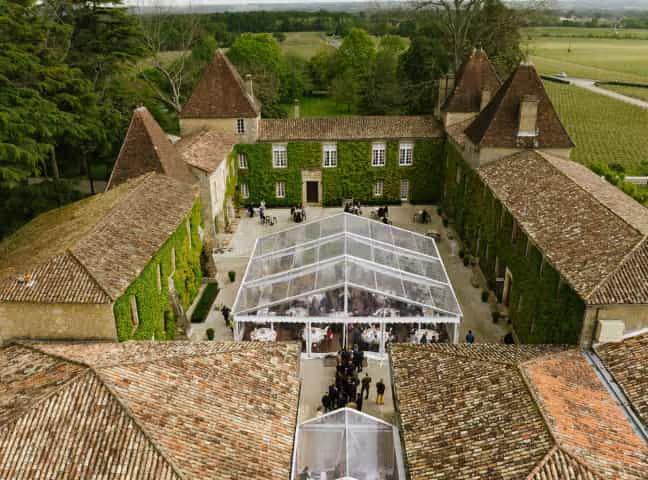
Some can host receptions as they are, while others will need adapting or the addition of temporary structures, such as a reception marquee.
It's also worth setting aside dedicated spaces for:
- catering;
- suppliers;
- dressing rooms;
- storage;
- technical areas.
Functional access
The quality of access routes has a direct impact on how an event runs.
In particular, it's worth checking:
- road access;
- parking;
- traffic flow;
- accessibility for people with reduced mobility;
- delivery areas.
Essential utilities
Finally, it's essential to check existing infrastructure:
- power supply;
- water supply;
- wastewater drainage;
- internet connection;
- mobile network coverage.
These elements ensure events run smoothly and make it possible to plan any necessary work before launching your events business.
Understanding the regulations before opening to the public
Turning a property into an event venue means complying with a number of rules. These are designed to guarantee people's safety, protect the site's surroundings and ensure events run smoothly.
Requirements vary depending on several factors: the type of events held, the capacity, the changes made, and the property's location. It's therefore best to factor these aspects in from the start of the project, to avoid unsuitable investments or last-minute paperwork.
The aim isn't to complicate your project, but to lay solid foundations for building a lasting events business.
If you're planning to install a tent or marquee, it's also essential to be aware of the regulations governing temporary structures (CTS).
Checking local planning rules
Before making any changes, it's advisable to check the planning rules that apply in your local area.
The local development plan (PLU in France) sets out:
- the permitted uses for your land;
- what development is possible;
- architectural constraints;
- parking rules;
- any restrictions on permanent or temporary structures.
A conversation with your local planning department will often quickly clarify what your property allows for.
Identifying site-specific constraints
Some properties are subject to specific regulations.
This is particularly true of:
- listed or heritage-registered buildings;
- protected areas;
- notable heritage sites;
- environmentally sensitive areas.
These constraints don't necessarily rule out developing an events business, but they can influence which changes are feasible.
Anticipating the main formalities
Depending on your project, various formalities may be required before you can host your first events.
These may include:
- planning permissions;
- procedures relating to hosting the public;
- checks on safety or accessibility.
As every project is different, it's advisable to have the key steps signed off before starting any work.
Designing a venue with organisers in mind
A beautiful setting is a real asset, but it isn't always enough to make an excellent event venue. Organisers also look for a practical site, where every space makes life easier for the various suppliers.
Caterers, florists, photographers, technicians and DJs all need to be able to work easily without disrupting the event.

Planning technical spaces
Although they stay out of sight for guests, some spaces are essential for an event to run smoothly.
It's advisable to plan for:
- a catering area;
- a storage area;
- a technical room;
- dedicated delivery access;
- staff-only areas.
These arrangements simplify the organisation and make life easier for suppliers on the day.
Making it easy to move around
Guest flow is often an under-estimated factor.
A well-designed event venue naturally connects the different spaces: parking, ceremony, drinks reception, reception hall, restrooms and outdoor areas.
Smooth guest flow improves the overall experience while making the event easier to run.
Making the most of outdoor spaces
Gardens, terraces, courtyards and parkland are often what really define a property.
They can host:
- a civil ceremony;
- a drinks reception;
- a wine reception;
- a lounge area;
- live entertainment;
- team-building activities.
The more flexible these spaces are, the more easily they can adapt to different types of events.

Investing in flexible, scalable solutions
Creating an event venue doesn't necessarily mean building something new.
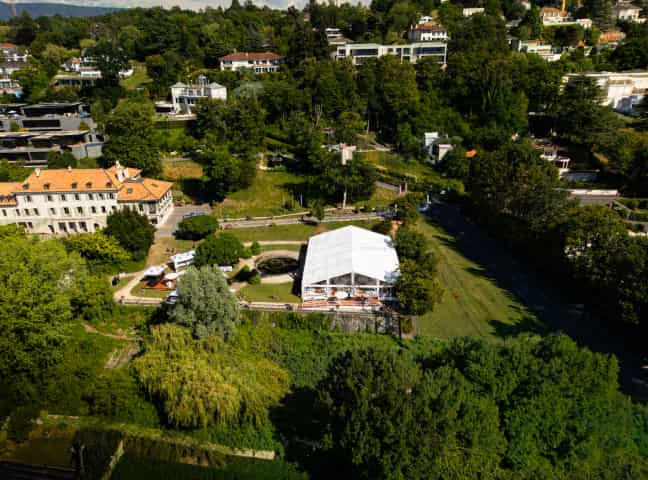
Many owners choose to grow their events business gradually using temporary structures. This approach makes it possible to try out different types of events while keeping initial investment down.
Modular structures offer a number of advantages:
- quickly increasing capacity;
- protecting guests from the weather;
- creating elegant covered spaces;
- adapting the set-up to the season;
- preserving the property's architectural character.
This approach also lets the project evolve at the pace of the business itself, without committing straight away to permanent building work.
A solution suited to many types of events
Temporary structures can be used to host:
- weddings;
- seminars;
- private receptions;
- corporate parties;
- conferences;
- cultural events.
Their modularity makes it easy to adapt floor space and equipment to each organiser's needs.

Choosing a business model suited to your project
Not all event venues operate in the same way. Some host a few events a year to complement an existing business, while others turn events into a fully-fledged activity of their own.
Before promoting your offering, it's important to define your positioning. This will help you target the right clientele, set your pricing and plan your investments.
Hosting weddings
Weddings remain one of the most promising markets. Couples are looking for characterful venues that can host their whole day: ceremony, drinks reception, dinner and evening party.
To meet these expectations, your property needs to offer a pleasant setting, functional spaces and solutions that can adapt to the weather.
Developing an offering for businesses
Businesses regularly look for event venues to hold:
- seminars;
- study days;
- strategic meetings;
- product launches;
- client evenings;
- team-building events.
These bookings offer a useful advantage: they're often held during the week, complementing the business generated by private events.
Diversifying how your property is used
Beyond weddings and seminars, your property can host many other types of events:
- birthday parties;
- exhibitions;
- concerts;
- makers' markets;
- food festivals;
- film shoots;
- community and charity events.
Diversifying your offering helps optimise your venue's occupancy rate throughout the year.

Mistakes to avoid before launching your business
Turning a property into an event venue is an exciting project, but certain mistakes can slow its development or lead to unnecessary costs.
Investing too quickly
Building a permanent venue straight away isn't always the best solution. Starting gradually makes it possible to test the market, fine-tune your offering and invest as the business grows.
Overlooking practical considerations
A beautiful venue isn't enough if suppliers struggle to do their job.
Parking, access, technical spaces and guest flow all play an essential role in an event's success.
Underestimating the guest experience
Guests remember the quality of the welcome just as much as the beauty of the setting.
Comfort, smooth guest flow, the equipment available and protection from the weather all contribute directly to guest satisfaction and the venue's reputation.
FAQ: Turning a private property into an event venue
Can any private property be turned into an event venue?
Most properties have some potential for hosting events, but each project needs to be assessed individually. The layout of the land, existing buildings, access, surroundings and planning rules all have a direct impact on feasibility. A preliminary study makes it possible to identify any technical or regulatory constraints and to define the most suitable changes.
What are the main steps before hosting events?
Before opening your property to the public, it's advisable to check your local planning rules and confirm your obligations regarding safety, accessibility and welcoming visitors. Planning for these steps in advance means you can build your events business on solid ground and avoid costly changes later on.
How can you increase capacity without building anything new?
Temporary structures are a particularly effective solution for quickly creating covered spaces. They make it possible to host more guests, protect events from the weather, and grow your business gradually without immediately committing to major building work or permanently altering your property.
What types of events can a private property host?
Depending on its layout, a property can host weddings, seminars, birthday parties, corporate events, private receptions, exhibitions and cultural events. What matters most is having spaces suited to organisers' needs, guest comfort and the specifics of each event.
How much does it cost to turn a private property into an event venue?
The cost of turning a private property into an event venue depends on several factors: the size of the property, the changes required, capacity, the equipment you want and the temporary structures chosen. As every project is unique, there's no standard price. A feasibility study makes it possible to assess your needs precisely and define a solution suited to your budget and goals.
Give your property a new dimension
Turning a private property into an event venue is a fantastic opportunity to showcase your estate, build a new business and create memorable experiences.
By taking the time to define your project, assess your property's potential and choose the right solutions, you can develop your site step by step while keeping control of your investment.
With its expertise and range of temporary structures, ATAWA has spent over 15 years helping owners of exceptional properties create elegant, flexible and durable event spaces.
Thinking about turning your property into an event venue?
The ATAWA team is on hand to look at your project and design a bespoke solution tailored to your site and your ambitions.
Get in touch to bring your future event venue to life.



Ile-de-France・Centre-Val de Loire
01 79 75 89 87

Provence-Alpes-Côte d’Azur・Corse
04 84 49 62 64
Nouvelle-Aquitaine
05 35 54 59 88
Hauts-de-France・Normandie
03 74 09 83 62
Bretagne・Pays de la Loire
02 57 64 07 94
Grand-Est・Bourgogne
03 52 74 06 68
Auvergne-Rhône-Alpes
04 28 29 61 35
Occitanie
05 82 95 39 28
Switzerland
+41 076 504 33 02
subtitle
Product name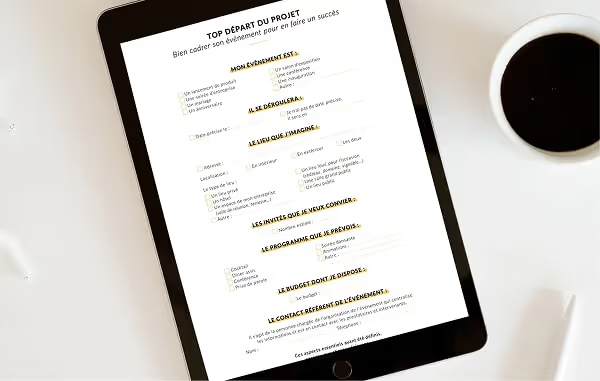
Discover the Atawa Guide
The Atawa Guide is the new essential tool for organizing your events: from launching your project to bringing it to life, no detail has been overlooked to ensure your event's success.