Hundreds of employees gathered together, a strategic message to convey, one or two days to make a lasting impression. A corporate convention is a large internal gathering that brings employees — and sometimes partners — together around a shared strategic message. Neither a seminar (smaller in scale) nor a congress (open and sector-wide): it is a format of its own — broader, more internal, more demanding.
And with this format, there is no room for approximation. Faulty sound, a poorly sized venue, and the entire event falls flat. This is why choosing the right setting matters as much as the programme itself.
Here is our guide to successfully organising a corporate convention, from defining objectives to turnkey infrastructure.

Why organise a corporate convention?
Convention, seminar, congress: what sets them apart
These three terms are often used interchangeably, yet they correspond to distinct formats. A wrong choice leads to sizing the duration, budget, venue and programme around a logic that doesn't fit the actual need. Three criteria help choose the right format: audience size, whether participants are internal or external, and the objective.
| Criterion | Convention | Seminar | Congress |
|---|---|---|---|
| Size | 100 to 1,000+ | 5–50 | Variable, open to the public |
| Audience | Internal | Restricted internal | External and sector-wide |
| Objective | Align and unite | Work in depth | Networking and visibility |
If your need is closer to a smaller, in-depth working format, a seminar is the right choice. Our dedicated guide to organising a corporate seminar walks you through the process.
The benefits of an annual convention for your company
Well designed, a corporate convention is far more than a large annual gathering: it is a strategic lever combining internal communication, employee experience and organisational alignment:
- Aligning and uniting teams around a shared vision: bringing all employees together in the same place at the same time creates an alignment effect that is hard to replicate any other way.
- Communicating a strategy, change or leadership vision: the annual corporate convention remains the most powerful format for delivering a large-scale message (new positioning, organisational transformation, post-merger integration). A well-crafted keynote, external speakers providing perspective, open discussion sessions: all ingredients that turn an announcement into a founding moment.
- Celebrating achievements and recognising contributions: a convention is also a moment of recognition. Spotlighting high-performing teams, showcasing remarkable projects, presenting internal awards: these sequences have far greater impact than an internal email. They fuel motivation and strengthen the sense of belonging.
- Strengthening company culture across departments, generations and sites: this is often the most underestimated benefit. A corporate convention brings together employees who never cross paths: sales and product teams, headquarters and subsidiaries, juniors and seniors. Breaks, gala evenings, team building workshops: these informal moments create cross-functional connections that enrich day-to-day work long after the event and accelerate onboarding for new joiners.

Organising a corporate convention: the 6 key steps
Step 1: define objectives and format
Everything starts with the "why". Without a clear goal, the convention misses its mark and becomes a costly event with no measurable impact. Key decisions to make upfront:
- business objective: strategic alignment, product launch, results celebration, annual kick-off;
- audience: all employees, extended leadership committee, or top management only;
- format: one day in-person, two-day residential, hybrid format with live streaming;
- timing: Q1 for a year kick-off, September for a post-summer momentum boost.
A clear brief on these points guides every subsequent decision: venue selection, programme, suppliers and budget.
Step 2: choose the ideal venue for a corporate convention
The venue defines what is possible for a corporate convention. A wrong capacity estimate, undersized secondary spaces, poor access logistics: these flaws undermine the experience regardless of the programme.
Structure your decision around:
- plenary capacity: the main room must comfortably seat all participants with no blind spots and no pressure on circulation;
- secondary spaces: workshops, catering and networking areas each deserve a dedicated, well-sized space;
- accessibility: proximity to a train station or airport, nearby accommodation, parking (every hour lost to logistics is one less hour on the programme);
- change of scenery: stepping outside the usual offices immediately creates an event atmosphere and drives engagement;
- equipped venue vs. open land: a pre-fitted site simplifies production, while an empty space opens up all scenographic possibilities — provided the right structures and equipment are deployed.
This is precisely where Atawa comes in: event tents and temporary structures for congresses deployed across France and internationally, to transform open land into a fully operational event site.

Step 3: build the programme
A convention programme that chains eight hours of top-down plenary sessions risks exhausting the audience before noon. The golden rule: alternate formats to sustain attention and give rhythm to the day.
Ingredients for a balanced programme:
- strong plenaries: opening keynote by a leader, vision-oriented speeches, external speaker to broaden perspectives;
- workshops and interactive formats: working groups, world cafés, co-construction sessions by business unit or challenge;
- informal time: generous breaks, seated meals, facilitated networking, gala evening;
- tempo variations: short TED-style inspiration talks, client testimonials, field experience feedback, immersive activities.
The goal is to ensure every participant alternates between listening, discussing and doing — every 45 to 60 minutes at most. To make a lasting impression and break away from classic formats, a range of original conference animation ideas can enrich your corporate convention.
Step 4: orchestrate logistics and infrastructure
This is where the quality of the experience is won or lost. A brilliant programme falls flat if the sound saturates, the room is poorly climate-controlled, or the plenary seating becomes uncomfortable after two hours.
For a successful corporate convention, plan ahead for:
- tent or temporary structure: on open land, a château, vineyard or industrial site, event tent rental reconstitutes all the necessary spaces (plenary, catering, workshops, lounges);
- furniture: each moment of the day calls for a different configuration — conference chairs for the plenary, round tables for meals, modular setups for workshops, and lounge furniture for breaks and networking zones;
- audiovisual: sound system calibrated to the audience size, stage lighting, LED screens, video capture for internal broadcast or hybrid streaming;
- logistics services: on-site catering, shuttle or group transport, accommodation;
- overall coordination: a single point of contact managing all suppliers, rather than twenty separate contacts to handle in parallel.
This last point makes all the difference on the day: a single coordinator secures timelines, streamlines last-minute decisions and frees up internal teams to focus on content.

Step 5: animate and engage participants
A memorable convention is not measured by the number of slides shown, but by the energy it brings to the room. The goal: turn a passive audience into active participants from the very first minutes.
Make the difference with:
- plenary staging: considered mise-en-scène, lighting effects, sound design — elements that set an atmosphere and signal to the audience that this moment matters;
- icebreakers on arrival: quality welcome, photo booth, short team game to activate collective energy before the first speaker takes the stage;
- live interactivity: live polls, facilitated Q&A sessions, tools like Mentimeter or Klaxoon to surface questions and reactions in real time;
- breakout workshops: deliberately mixing participants across departments, seniority levels and sites to build cross-functional connections and strengthen team cohesion.
Step 6: capitalise on the convention
Day +1 is not the end of the event — it is the beginning of its diffusion. A well-capitalised convention extends its impact over months and feeds internal communication throughout the year:
- debrief within 48 hours: key messages summary, standout photos, leadership quotes — sent while the event is still fresh in everyone's minds;
- highlights video: a 2–3 minute format condensing the energy of the convention, usable internally (intranet, onboarding) and externally (employer brand, social media);
- satisfaction survey: NPS, programme quality, perception of the strategic message — to measure real impact and identify areas for improvement;
- management relay plan: briefing managers as message ambassadors;
- follow-up KPIs: engagement rate, message retention over time (measured at M+3 and M+6), qualitative ROI around culture, motivation and strategic alignment.
Organising a corporate convention with Atawa: the turnkey solution
A comprehensive offer: from venue to furniture
Organising a corporate convention involves dozens of suppliers — one per task, one per trade, each bringing its own contracts, schedules and risks of misalignment. Atawa brings nine trades together under a single point of contact: tents and temporary structures, furniture, crockery, flooring, décor, lighting, sound and video, energy, sanitary facilities. A comprehensive catalogue covering the full scope of the event world, with no subcontractors for the client to manage.
On the ground, this integration translates into modular furniture adapted to every key moment of the convention: rows of conference chairs for the plenary, round tables for meals, modular configurations for workshops, lounge furniture for breaks and networking zones.
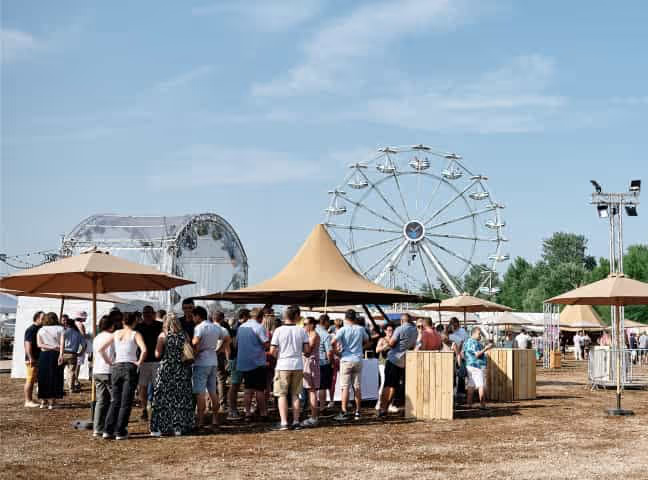
When the chosen venue is open land, a wine estate or an industrial site with no existing infrastructure, temporary structures take over: event tents, domes or bamboo marquees make it possible to deploy the convention where it could not otherwise have existed.
Present across France, Atawa coordinates the entire setup from a single point of contact. The result: significant time savings for internal teams and overall visual consistency across all event spaces.
The Volkswagen convention: a concrete case
For its annual convention, Volkswagen brought together 675 participants at the Château de Villers-Cotterêts in the Aisne region. Atawa deployed a crystal tent in the château courtyard, integrated a full rain contingency plan to secure the outdoor reception, and coordinated the entire setup from design to dismantling.
A successful, elegant evening — allowing the brand to focus entirely on its teams and partners with no parallel logistical management.

FAQ — Your questions about organising a corporate convention
What budget should you plan for a convention?
Allow between €200 and €600 per participant for a one-day corporate convention, and between €400 and €1,200 for a two-day residential format with accommodation.
For 200 people, the total budget therefore ranges from €40,000 to €120,000 depending on the level of quality sought. Venue, catering and audiovisual alone account for nearly three quarters of the total budget.
How long should a corporate convention last?
A corporate convention typically lasts one or two days. The one-day format suits kick-offs and conventions focused on a single strategic message. The two-day format allows topics to be explored in depth and team cohesion to be reinforced through informal time together.
How many participants does a corporate convention bring together?
A corporate convention typically gathers between 100 and 1,000 participants, sometimes more for large groups. Below 100 people, the format is generally considered a seminar; above 1,000, it becomes an international large-scale gathering with specific logistical constraints (interpretation, multi-site broadcasting, large-capacity temporary structures).


Ile-de-France・Centre-Val de Loire
01 79 75 89 87

Provence-Alpes-Côte d’Azur・Corse
04 84 49 62 64
Nouvelle-Aquitaine
05 35 54 59 88
Hauts-de-France・Normandie
03 74 09 83 62
Bretagne・Pays de la Loire
02 57 64 07 94
Grand-Est・Bourgogne
03 52 74 06 68
Auvergne-Rhône-Alpes
04 28 29 61 35
Occitanie
05 82 95 39 28
Switzerland
+41 076 504 33 02
subtitle
Product name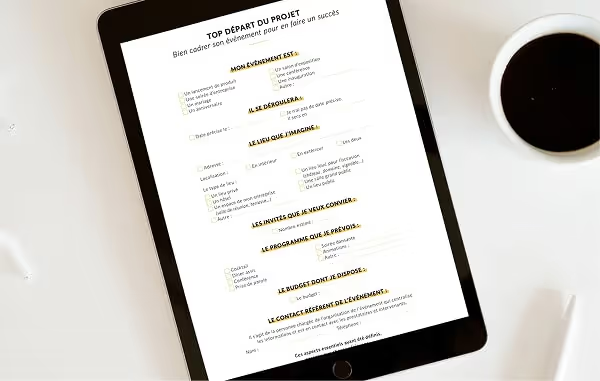
Discover the Atawa Guide
The Atawa Guide is the new essential tool for organizing your events: from launching your project to bringing it to life, no detail has been overlooked to ensure your event's success.