The sky clouds over a few hours before the guests arrive. The wind picks up during set-up. The temperature exceeds the forecast, and areas exposed to the sun quickly become uncomfortable.
The weather cannot be controlled. Its consequences, however, can be anticipated. Organising an outdoor event is therefore not just a matter of checking the forecast a few days before the date. The venue, the ground, the event structure, access routes, technical equipment and the backup plan must all be considered from the very start of the project.
The goal is not to prepare for the worst-case scenario at every turn, but to build an organisation capable of adapting without compromising safety, guest comfort or the aesthetics of the setup.

Why anticipate the weather from the very design of the event?
A shower is not always enough to disrupt an event. However, a buffet set up without protection, ground that has become unusable, or electrical installations exposed to moisture can quickly complicate proceedings.
Heat can also turn a pleasant cocktail reception into a trying experience when shaded areas, ventilation and water points are insufficient.
Wind poses an even greater risk. It can affect structures, hanging elements, signage, screens and lightweight furniture.
Anticipating the weather constraints of an event helps protect three essential elements:
- participants and staff;
- the installations and equipment;
- the continuity of the programme.
The weather should therefore be factored into the choice of venue, the layout of the spaces and the selection of the event tent or temporary structure.
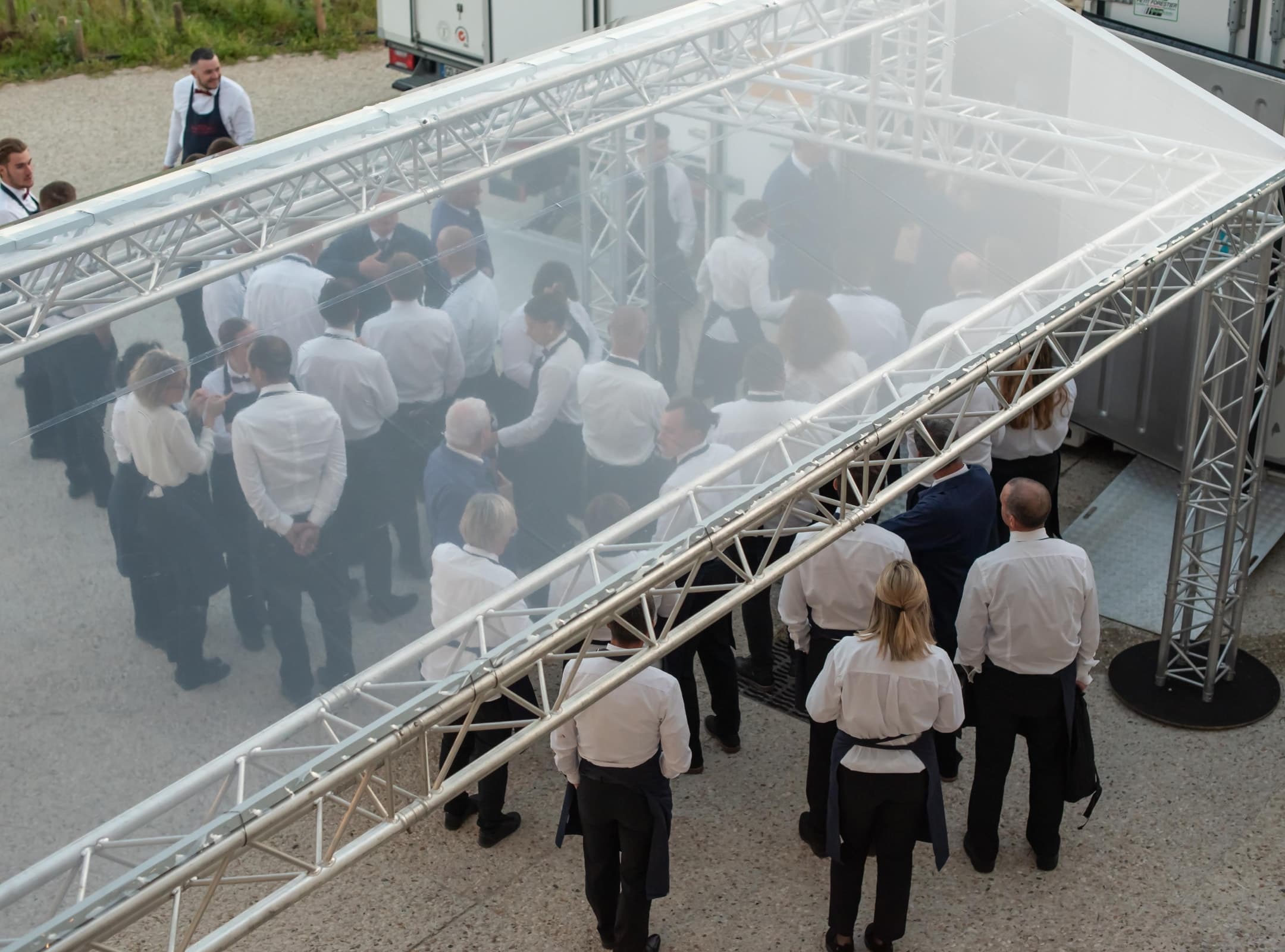
Observe the venue before checking the forecast
Forecasts give a general trend, but on their own they don't reveal how a site will actually respond to rain, wind or heat.
A technical site visit is essential to identify points requiring attention and to plan the right installations.
Identify wind-exposed areas
A space surrounded by buildings can create corridors where wind accelerates. Conversely, a fully enclosed courtyard can lack ventilation and trap heat.
It's important to identify the most exposed areas, the naturally sheltered spaces, and any elements that could be affected by gusts: trees, panels, parasols, hanging décor or lightweight furniture.
This analysis makes it possible to position the structure, the stage, the catering areas and the circulation zones in the most suitable spots.
Study water drainage
A lawn or courtyard may appear perfectly usable during a site visit, then hold a significant amount of water after prolonged rain.
The slope of the ground, low points, drainage systems and delivery access must be checked before set-up.
Depending on the type of ground, it may be necessary to plan for technical flooring, duckboards or trackway panels.
This equipment helps stabilise the installations and keeps walkways comfortable for guests.
Observe sun exposure
A terrace that's pleasant early in the evening may be fully exposed during the hottest hours of the day.
A clear-roof tent can also create a greenhouse effect if its orientation, openings and ventilation aren't planned in advance.
The site should therefore be observed at the actual times of the event to identify shaded areas, the hottest spots and temperature variations between day and evening.

How to protect an outdoor event from the rain?
Rain doesn't necessarily mean the event has to be fully enclosed.
The right structure can protect an outdoor event from rain while preserving the view of the venue and the feeling of being outdoors.
The priority areas to cover are generally:
- guest reception;
- catering;
- the stage and speeches;
- audiovisual equipment;
- the main circulation areas.
Side walls can be added when rain is accompanied by wind. Whether transparent or opaque, they need to be quick to open or remove if conditions change.
Water drainage must also be planned for. Gutters, downpipes and drainage areas should prevent water from pooling around entrances.
The ground deserves particular attention. Flooring, suitable matting or duckboards help keep circulation smooth when the ground becomes wet.
Cables, electrical connections, technical control areas and audiovisual equipment must also be protected against moisture.
Which event structure should you choose to handle bad weather?
Not all structures serve the same purpose or offer the same level of protection.
The choice depends on the season, the venue, the number of guests, the duration of the event and the expected level of comfort.
The stretch tent for an open atmosphere
The stretch tent suits cocktail receptions, garden parties and events looking to keep a direct connection with the outdoor surroundings.
It protects against sun and moderate rain while creating an open, welcoming space.
Its layout and anchor points must be planned according to the type of ground and exposure to wind.
It can also be complemented with flooring, outdoor furniture and suitable lighting equipment.
The clear-roof tent to make the most of the scenery
The clear-roof tent creates a covered space while keeping an unobstructed view of the site.
It's particularly well suited to dinners, galas and upscale receptions.
Its sun exposure does, however, need careful consideration. Suitable ventilation and opening certain walls may be necessary to limit heat build-up.
In the event of rain, gutters, downpipes and a stable floor help preserve guest comfort.

The enclosed structure for better climate control
It also allows for better control of temperature, ventilation and air intake.
The surface area needs to be sized with the originally planned outdoor spaces in mind. In case of bad weather, guests, furniture and entertainment must be able to be brought together under the structure without hindering circulation.
Choosing an outdoor event structure should therefore go hand in hand with an overall approach to flooring, access, heating, ventilation and technical equipment.
Whether it's for tent rental in Geneva or tent rental in Lausanne, Atawa offers elegant, sturdy structures suited to the climate conditions of each region and to every type of event.
How to organise an event during a heatwave?
Heat can quickly affect guest comfort, particularly when the event takes place in direct sunlight or under a transparent structure.
Create enough shaded areas
Reception, catering and rest areas should be protected from the sun.
Shade sails, parasols or open structures help spread guests across several zones.
Queues, buffets and seating should not be positioned in the most exposed spots during the hottest hours.
It's also useful to set up clearly identified rest areas, with comfortable seating and water nearby.
Encourage air circulation
Before considering air conditioning, effective natural ventilation should be the first priority.
Opening the walls, orienting the structure correctly and creating cross-ventilation can considerably improve comfort.
Fans or air coolers can complement this setup.
In a clear-roof tent, these elements need to be planned from the design stage to avoid a greenhouse effect that's hard to correct on the day of the event.
Adapt the schedule and activities
Long speeches, physical activities and queues should be kept to a minimum during the hottest periods.
Water should remain visible and easily accessible throughout the event.
Misting fans, hand fans and rest areas can also be made available.
Guests should be informed in advance when light clothing, sun protection or particular footwear is recommended.
Organising an outdoor event during a heatwave therefore means adapting the installations, the programme and the communication with guests all at once.
What should you plan for in case of strong wind?
Wind is one of the most sensitive risks for an outdoor event.
It can affect temporary structures, décor, panels, screens and hanging equipment.
The structure must be anchored or weighted according to the ground conditions and the forecast.
Decorative elements and furniture must also be properly secured.
Warning thresholds should be defined before the event. They can lead to several decisions:
- removing certain decorative elements;
- changing how the walls are opened;
- moving an activity;
- closing off a zone;
- activating the event's backup plan.
On the day, one person should be responsible for tracking how conditions evolve and coordinating decisions with the technical teams.
This kind of organisation avoids improvised reactions and ensures everyone involved knows the procedure to follow in case of strong wind during an event.
How to protect guests from the cold?
Powerful heating is not always enough to maintain a comfortable temperature.
Comfort depends on the volume of the structure, the outdoor temperature, the number of openings and how often people pass through.
Suitable walls help limit air draughts. An airlock installed at the entrance also reduces heat loss.
The placement of heaters must be planned to spread heat evenly across the space without hindering movement.
Heating for an event tent must be sized according to the volume, the season and the structure's level of insulation.
Catering and lounge areas require particular attention, as guests stay there longer and feel the cold more.
Hot drinks, textiles, cushioned seating and lounge areas can also help with overall comfort.
Why plan a backup option for an outdoor event?
A good backup plan for an outdoor event shouldn't be improvised the moment it starts raining.
It should be designed as a full second configuration of the event.
Where will the buffet, the stage and the guests be moved to? Is the covered space large enough? Do the electrics, furniture and circulation still work? Do the suppliers know what to move, and in what order?
The backup space needs to accommodate not just the guests, but also the technical equipment, catering areas, furniture and circulation zones.
The backup plan must be validated with the same level of precision as the main scenario.
When this preparation is done well, guests don't notice a downgraded event. They simply experience one that adapts smoothly.
When should weather-related decisions be made?
Following the forecast isn't enough. You also need to know when to make a decision.
Several days before the event
The general trend makes it possible to adjust equipment, the structure's configuration and certain set-up times.
This is the moment to confirm heating, ventilation, side wall and additional protection requirements.
Teams can also check the availability of equipment needed to activate the backup plan.
The day before the event
Organisers confirm the main scenario or prepare the switch to the backup configuration.
Suppliers need to know the chosen configuration, any scheduling changes and the equipment to install.
Information for guests can also be prepared at this stage.
On the day
Regular monitoring makes it possible to adapt how the space is used: opening walls, switching on heating, moving an activity or closing off a zone.
Precise thresholds can be set with the technical teams for wind, temperature or rainfall.
This organisation avoids conflicting decisions and late reactions.
How to protect technical equipment?
Rain, humidity, heat and cold can affect electrical installations, sound systems, and screens and audiovisual equipment.
Cables must be protected, and connections should not be installed in areas prone to holding water.
Control booths, screens and broadcasting systems need suitable protection.
During periods of intense heat, some equipment can also overheat. Their ventilation and placement must therefore be planned in advance.
Technical teams need to know the event's backup plan and be able to quickly move or shut down an installation if conditions change.
Informing guests without causing concern
Communication is an integral part of managing an event's weather-related risks.
For an outdoor event, the invitation can recommend suitable clothing, comfortable footwear, sun protection or a warm layer for the evening.
In the event of a significant change, guests should receive clear, prompt information: a new access point, a relocated reception area, a revised schedule or a change in configuration.
The message should reassure without overdramatising.
The aim is to show that the event remains perfectly organised despite changing conditions.
Clear on-site signage also helps guide guests when access points or spaces have been changed.
Coordinating suppliers around a single scenario
The caterer, technical teams, reception staff, hosts and security teams all need access to the same information.
An up-to-date running order should specify the chosen scenario, the usable areas, access points, timings and any adjustments.
Each supplier needs to know what to move, protect or change if the backup plan is activated.
This coordination avoids conflicting decisions and wasted time.
It also helps preserve the guest experience, who should never sense any urgency or hesitation on the organisers' part.
How does Atawa safeguard events against the weather?
At Atawa, weather constraints are factored in from the very start of the project's design.
The choice of event structure, flooring, anchoring, ventilation, heating, access points and power supply are all planned according to the venue, the season and the format of the event.
The technical site visit helps identify the risks linked to wind, rain, heat, cold and ground conditions.
The different configurations are then designed to preserve the event's flow, aesthetics and comfort.
Because a successful event doesn't depend on perfect weather. It depends, above all, on an organisation that has planned for what could happen.
FAQ on weather and organising an outdoor event
How to protect an outdoor event from the rain?
To protect an outdoor event from the rain, you need a suitable event tent or covered structure, along with stable flooring and good water drainage. Access points, catering areas, the stage, electrical installations and audiovisual equipment must also be protected. Side walls can be added if the rain is accompanied by wind.
What backup plan should you prepare for an outdoor event?
The backup plan for an outdoor event should provide a full, immediately usable second configuration. You need to define the backup space, its capacity, furniture, electrics, access, catering and guest circulation. Suppliers also need to know exactly which equipment to move, in what order, and when the backup plan should be activated.
How to organise an event during a heatwave?
To organise an outdoor event during a heatwave, create shaded areas, encourage air circulation and make water easily accessible. The schedule, activities and speeches can also be adjusted to avoid the hottest periods. Fans, misting systems, rest areas and clothing guidance also improve guest comfort.
What should you do if strong wind is forecast?
In the event of strong wind, structures, décor, panels, screens and furniture must be secured or removed if necessary. Warning thresholds should be set with the technical teams. Depending on the wind's intensity, it may be necessary to close off a zone, change how the walls are opened, move an activity or activate the backup plan.
When should you start monitoring the weather for an event?
The weather should be factored in from the moment the venue is chosen and the event is designed. Seasonal trends help identify the main risks, and the forecast should then be monitored several days before the date. The day before and on the day itself, regular monitoring makes it possible to adjust the structure, equipment, schedule and programme if conditions change.




Atawa in Switzeland
+41 076 504 33 02

Atawa in France
+33 1 79 75 89 87
subtitle
Product name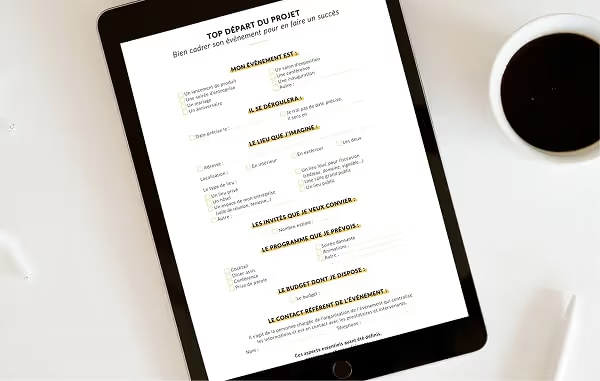
Discover the Atawa Guide
The Atawa Guide is the new essential tool for organizing your events: from launching your project to bringing it to life, no detail has been overlooked to ensure your event's success.